
Market Notes
The “Affair Rally”: We Fact-Checked the Internet’s Worst Trading Strategy
A viral meme says stocks soar after the boss gets caught cheating. We recomputed every number, then read the 325-case study that says the opposite. We do not condone any of it.

Written by Drew Sweetman
Founder, Element Squared Private Wealth

This week the internet discovered a new stock market indicator. Before we go further, our compliance department has asked us to open with a statement: Element Squared does not condone infidelity, does not condone workplace relationships that break company policy, and does not condone building a portfolio out of either. With that on the record, we ran the numbers, because somebody had to.
How we got here
A very bad week at Nvidia
On November 8, Nvidia co-founder and chief executive Jensen Huang sent a letter to employees, which the company published, that said: "I was unfaithful to my wife." He apologized and asked that his family be given privacy. We will do exactly that. This post is about stock market math and nothing else.
Four days later Nvidia filed a Form 8-K with the SEC: the board had accepted Mr. Huang's resignation as president, chief executive and director on November 11 and named chief financial officer Colette Kress interim CEO. His letter also said the board has opened an independent investigation into "the national security concerns raised in news reports." That is a matter for the board and the authorities, and we will not guess at it.
October 28 to November 12, 2026
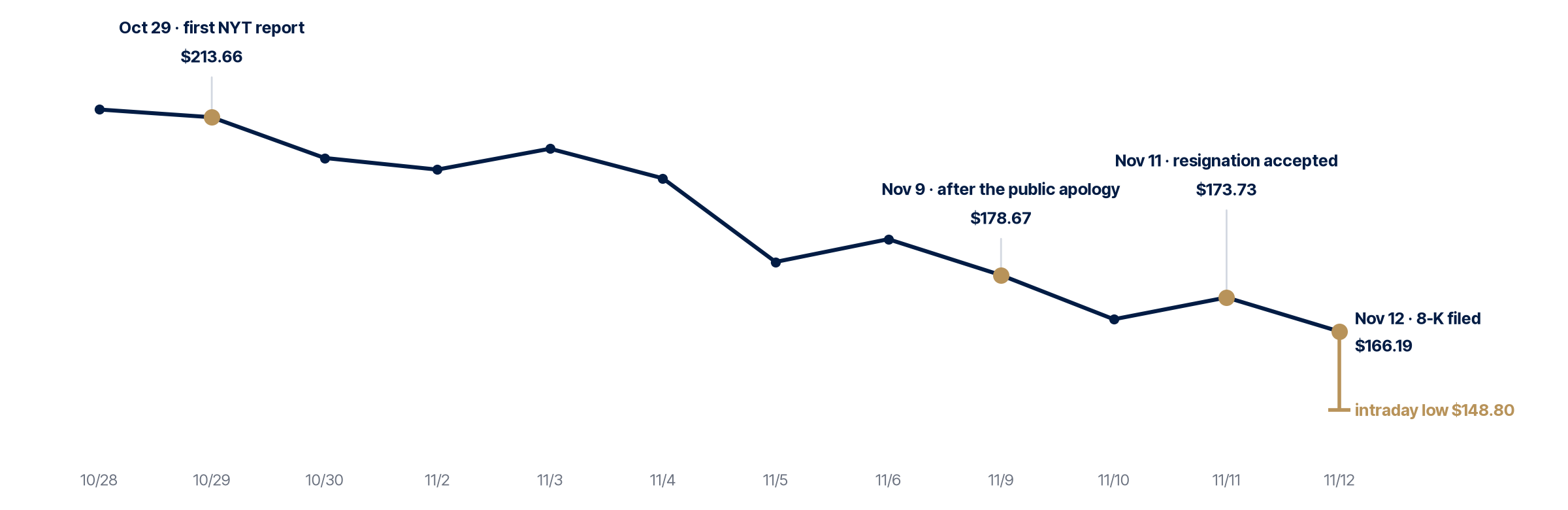
Nvidia closed at $215.38 on October 28, the day before the New York Times published its first report, and at $166.19 on November 12, a decline of 22.8 percent. Over the same days a broad semiconductor fund fell 10.9 percent and the S&P 500 fell 2.0 percent. On the morning of the 8-K the stock opened 13.1 percent lower, then recovered to finish down 4.3 percent.
The meme
Enter the "Affair Rally"
That rebound was all social media needed. A post that went viral this week reads: "Every CEO who got caught cheating saw the stock rip after." It lists Amazon up 213 percent, Microsoft up 114 percent, Alphabet up 1,244 percent and SK Hynix up 3,563 percent, and concludes that Nvidia "is the only one still waiting." Another claims a portfolio of "CEOs who had affairs" beat the S&P 500 over twenty years, with no method, holdings or start date attached, which is a bold way to present a backtest.
Our compliance department would like to remind you that this is not a strategy. It is, however, a testable claim.
1. The numbers are roughly right. The benchmark is missing.
We recomputed all four from the last close before each story broke through November 12, 2026, with dividends included. The meme's figures hold up.
Total return from the last close before the news to November 12, 2026
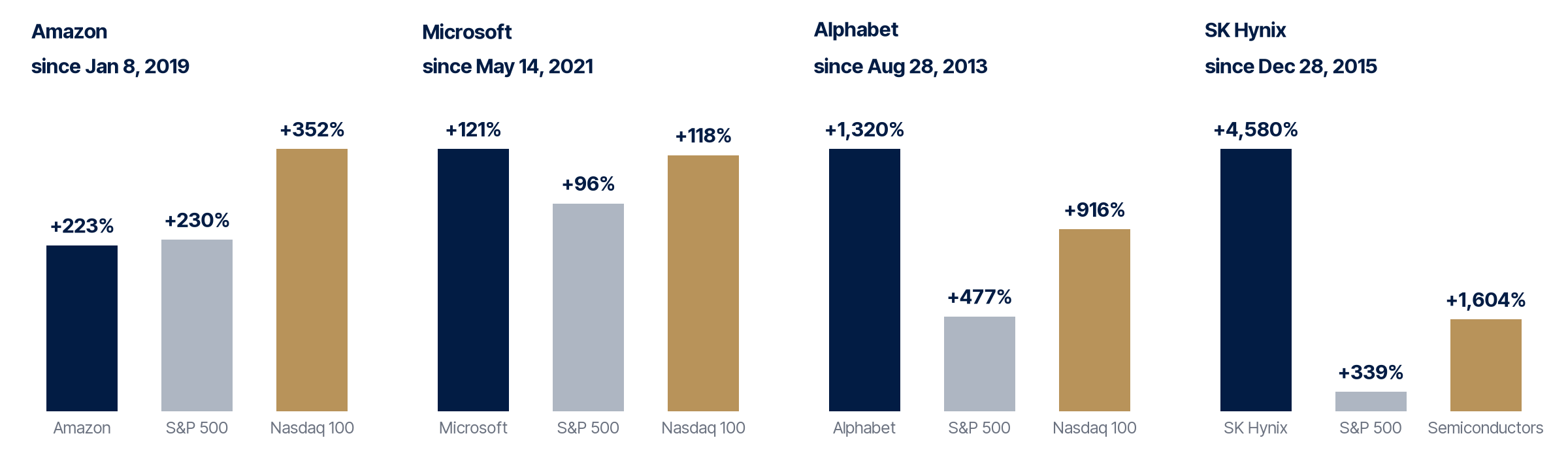
Now look at the bars next to them. Amazon is up 223 percent since January 2019. The S&P 500 is up 230 percent. The Affair Rally's lead exhibit trailed an index fund. Microsoft is up 121 percent against 118 percent for the Nasdaq 100, which works out to three points of scandal alpha in five and a half years. Alphabet and SK Hynix did beat their benchmarks, for reasons we will get to.
| Company | News date | First day | First 12 months | S&P 500, same 12 months |
|---|---|---|---|---|
| Amazon | Jan 9, 2019 | +0.2% | +14.2% | +28.8% |
| Microsoft | May 16, 2021 | −1.2% | +6.1% | −2.3% |
| Alphabet | Aug 28, 2013 | +0.8% | +36.6% | +24.5% |
| SK Hynix | Dec 29, 2015 | +1.0% | +50.2% | +12.6% |
The first-day column is the tell. The market's reaction to all four stories was a shrug of about one percent. Nothing "ripped."
2. Three of the four "CEOs" were not the CEO
- Amazon, 2019. Jeff Bezos, who was the CEO, announced his divorce on January 9, 2019, and a tabloid report about a relationship followed. He ran the company until 2021.
- Microsoft, 2021. The Wall Street Journal reported that Microsoft's board had looked into a past relationship between Bill Gates and an employee. His spokeswoman acknowledged "an affair almost 20 years ago." He had not been CEO since 2000.
- Alphabet, 2013. AllThingsD reported that co-founder Sergey Brin and his wife had separated, which a spokesperson confirmed, and that he was in a relationship with a Google employee. Larry Page was the CEO.
- SK Hynix, 2015. Chey Tae-won, chairman of SK Group, which controls SK Hynix, acknowledged an extramarital relationship in a letter to a Korean newspaper. He was not the chipmaker's CEO.
In all four cases nobody was removed and the business carried on. Alphabet did not rise 1,320 percent because of a 2013 gossip item. It rose because of search advertising, YouTube and cloud computing. Four founder-controlled technology giants, picked in hindsight during a long technology bull market, went up. That is survivorship bias, and it is all the meme proves.
The serious part
3. Somebody already did this study properly
In 2018 three finance professors, Brandon Cline of Mississippi State, Ralph Walkling of Drexel and Adam Yore of Missouri, published "The consequences of managerial indiscretions: Sex, lies, and firm value" in the Journal of Financial Economics, one of the field's top journals. They did not pick four winners. They collected 325 cases in which a senior executive was accused of a personal indiscretion in one of four categories: dishonesty, substance abuse, sexual misadventure or violence.
The design is the clever part. Every case was personal and had nothing to do with the company's operations. So the stock's reaction measures one thing: what the market thinks it just learned about the person in charge.
Average immediate loss in firm value, Cline, Walkling and Yore (2018)
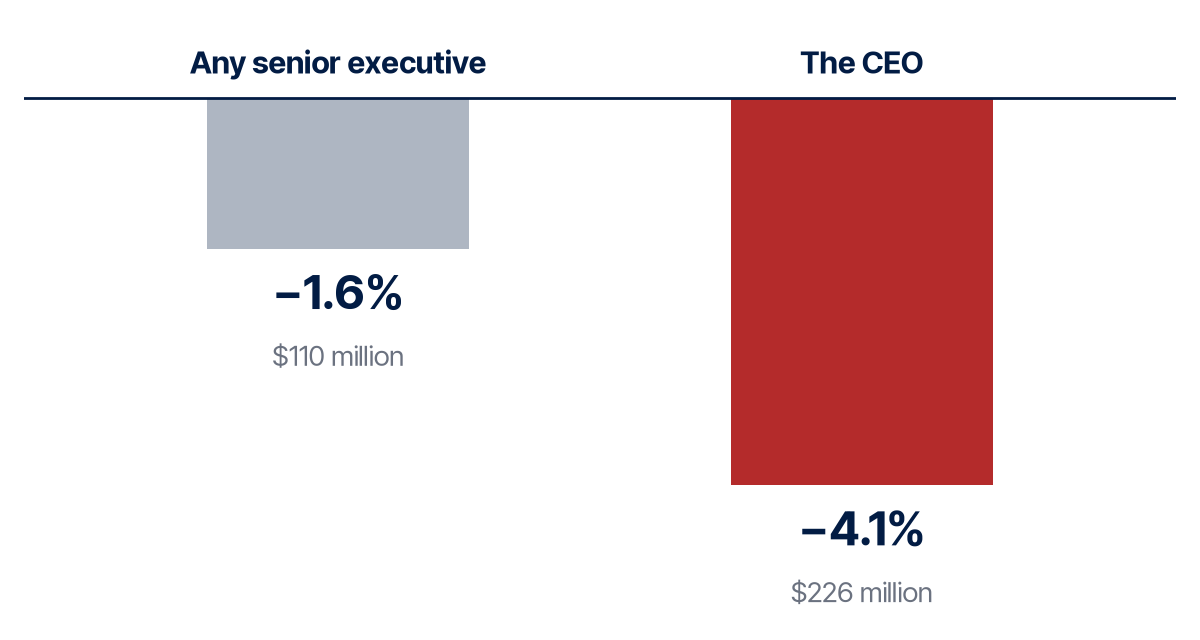
The market does not rally. On average, the authors found "an immediate 1.6% loss in shareholder value," or about $110 million. When the executive is the CEO, the loss is 4.1 percent, or $226 million.
They also found the losses were too large to be explained by legal bills and severance. Most of it, they concluded, is reputation: investors marking down a company because they trust its leader less.
The paper then follows these companies after the headlines fade.
- The business gets worse. Profit margins and return on assets show an abnormal decline. When the CEO is the one involved, the company signs significantly fewer new major customers and joint-venture partners. Counterparties, it turns out, read the news too.
- It is rarely the only problem. These firms are significantly more likely to manipulate earnings, and more likely to face shareholder class actions or fraud charges from the Justice Department or the SEC over unrelated matters. As Professor Yore put it: "Personal integrity at the top matters and can have major impacts on these companies."
- Careers pay for it. The probability the CEO loses the job rises by 41 percent. CEOs who survive see salary and bonus fall by about $400,000, and directors lose votes at the next election.
- Lying costs the most. Of the four categories, the university's summary of the paper says dishonesty did the most damage.
- Governance predicts it. Indiscretions occur more often at poorly governed firms, where a board is less likely to act.
One finding is funny in a bleak way. In industries the authors classify as "shady," meaning those with a habit of breaking federal rules, the stock reaction was smaller. The market was not surprised.
The paper's conclusion is the opposite of the meme. Personal integrity at the top is an asset of the company. When it is impaired, shareholders pay.
4. What happens when the CEO actually leaves
None of the meme's four companies lost its leader. Nvidia just did. So we built the comparison the meme should have used: six large companies whose chief executive left over personal conduct. Most were not "affairs" at all. They were violations of company policy or failures to disclose.
- Boeing, 2005. Harry Stonecipher resigned at the board's request over a relationship with a company executive.
- Hewlett-Packard, 2010. Mark Hurd resigned after an investigation found violations of HP's standards of business conduct, though not of its harassment policy.
- Best Buy, 2012. Brian Dunn resigned during a board investigation, which later reported a close personal relationship with an employee that violated company policy.
- Intel, 2018. Brian Krzanich resigned over a past consensual relationship with an employee, against Intel's policy for managers.
- McDonald's, 2019. The board removed Steve Easterbrook over a consensual relationship with an employee that violated company policy.
- BP, 2023. Bernard Looney resigned after acknowledging he had not been fully transparent with the board about past relationships with colleagues.
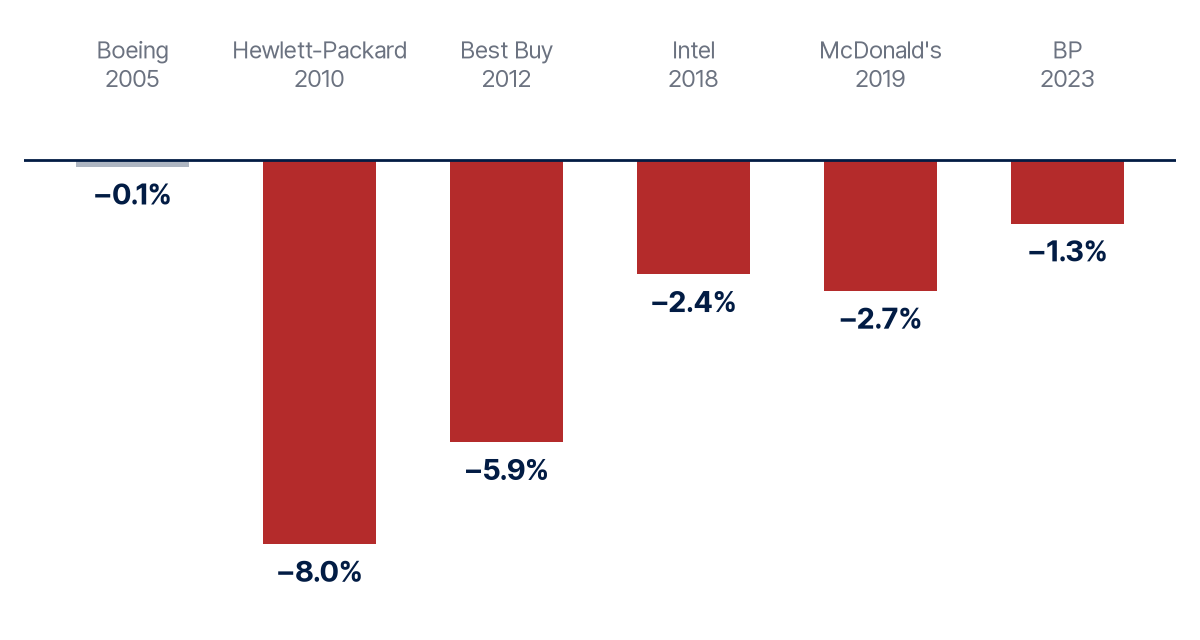
Price change on the first session after the announcement
Total return, stock and S&P 500
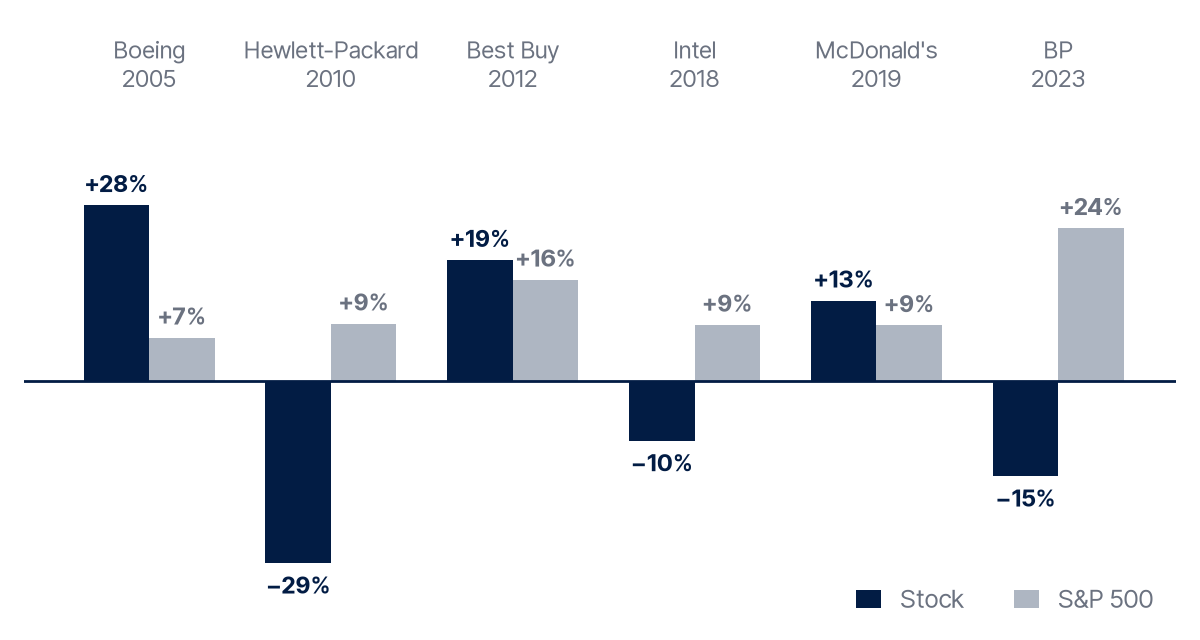
All six closed lower on the first day. The average decline was 3.4 percent, close to the 4.1 percent the study found for CEOs. Six cases is an anecdote, but one that agrees with the research.
After twelve months it was a coin flip: three beat the S&P 500 and three trailed it. After the first day, the business decides.
5. Two more studies, briefly
The damage tends to be short-lived. A 2015 paper in Applied Economics by Jory, Ngo, Wang and Saha studied scandals tied directly to a CEO between 1993 and 2011. Investors reacted badly in the short run, but over the long run the stocks performed in line with similar companies, and operating results were better afterward.
The market cannot price what it does not know. A 2019 study in PNAS by Griffin, Kruger and Maturana matched executives to leaked data from a marital-infidelity website. Companies whose CEO or CFO was a paying user were more than twice as likely to engage in corporate misconduct. There was no stock reaction when the data leaked, but there was also no press coverage naming those executives. That is not a market that does not care. It is a market that had not been told.
So is Nvidia "still waiting"?
We do not know where Nvidia's stock goes next, and neither does the person who made the meme. It is the one name on the meme's list whose founder actually left, which makes it a different event from the other four.
The takeaway
Three things worth keeping
Character is a financial variable
The best evidence says the market charges for integrity problems at the top, and that they travel with other problems.
Founders are not interchangeable parts
The meme's winners kept their builders. Replacing one overnight is a real business event.
Four winners is not a study
Any list assembled after the fact will "work." Ask what the benchmark did and who is missing.
At the request of our compliance department, one final time: we do not condone any of the behavior described above, and "the CEO's personal life is a mess" is not an investment thesis. It is barely a tweet.
We compare how your current portfolio has performed against our models over the same periods, and tell you plainly whether a change makes sense.
Sources
Cline, Walkling and Yore, "The consequences of managerial indiscretions: Sex, lies, and firm value," Journal of Financial Economics 127(2), 2018, 389–415 (paper; authors' summary, Harvard Law School Forum on Corporate Governance; Drexel University summary; University of Missouri summary). Jory, Ngo, Wang and Saha, "The market response to corporate scandals involving CEOs," Applied Economics 47(17), 2015, 1723–1738 (paper). Griffin, Kruger and Maturana, "Personal infidelity and professional conduct in 4 settings," PNAS 116(33), 2019 (paper). Nvidia: Form 8-K dated November 11, 2026 and "A Message to Our Company". The meme: post on X, November 9, 2026. Historical events are described from the companies' own announcements and contemporaneous reporting by the Wall Street Journal, AllThingsD and the Korea JoongAng Daily; the Nvidia timeline follows TechCrunch. Prices: Yahoo Finance and Financial Modeling Prep, closing prices through November 12, 2026. Twelve-month and since-news figures are total returns with dividends reinvested; first-day figures are price changes. S&P 500, Nasdaq 100 and semiconductors are represented by the SPY, QQQ and SOXX exchange-traded funds. SK Hynix is in Korean won and BP is the New York-listed share.
Important disclosures
Not investment advice. This commentary is provided for general informational and educational purposes only. It reflects the opinions of Element Squared as of the date shown, which may change without notice, and it is not personalized investment advice, an offer, or a recommendation to buy or sell any security or to adopt any strategy. Any investment decision should follow a full review of your objectives, risk tolerance, time horizon, tax situation, liquidity needs and other holdings, ideally with a qualified professional.
Securities and indices mentioned. References to specific companies, funds, indices or price levels are for illustration only and are not recommendations. Element Squared, its clients or its employees may hold positions in securities discussed and may change those positions at any time without notice.
Risk of loss. All investing involves risk, including the possible loss of principal. Past performance, whether actual or hypothetical, is not a guarantee or reliable indicator of future results. Historical market patterns described here may not repeat, and indicators or frameworks discussed may fail to anticipate future market behavior.
Data and forward-looking statements. Market data is drawn from third-party sources believed to be reliable but is not guaranteed for accuracy or completeness. Statements about future events, scenarios or outcomes are forward-looking, involve uncertainty, and may not come to pass. An investor cannot invest directly in an index.
Registration and fiduciary status. Advisory services are offered through Element Squared LLC, doing business as Element Squared Private Wealth, an investment adviser registered with the U.S. Securities and Exchange Commission. Registration does not imply a certain level of skill or training. As a registered investment adviser, Element Squared is a fiduciary and is required to act in its clients' best interests. Additional information, including Form ADV Part 2A and the firm's Client Relationship Summary, is available upon request and at adviserinfo.sec.gov.
Free guide
Your old 401(k), in four parts.
What happens to it, what it costs you to leave it, and how a rollover actually works.
Get the guide →Keep reading
All insights →
Market Notes
15 Things in Anthropic’s IPO Filing You Won’t Believe Are Real
It lost $80 billion while turning a profit, its AI writes 90 percent of its code, and one share of stock controls the company. The strangest IPO prospectus ever filed, in 15 facts.
 November 8, 20266 min read

Market Notes
Shakeout or Breakdown? Scoring the AI Correction in Real Time
Element Squared's playbook for reflexive bubbles, five historical tests of major trends, and a live seven-check scorecard for the 2026 AI trade.
November 6, 20264 min read
Market Notes
Anatomy of a Stock Buyback Death Spiral
S&P 500 companies spent over $900 billion on stock buybacks in 2024. Learn how to tell when share repurchases create value for shareholders — and when debt-funded buybacks signal a dangerous death spiral that could collapse a company’s stock price.
March 29, 202611 min read