
Market Notes
15 Things in Anthropic’s IPO Filing You Won’t Believe Are Real
It lost $80 billion while turning a profit, its AI writes 90 percent of its code, and one share of stock controls the company. The strangest IPO prospectus ever filed, in 15 facts.

Written by Drew Sweetman
Founder, Element Squared Private Wealth
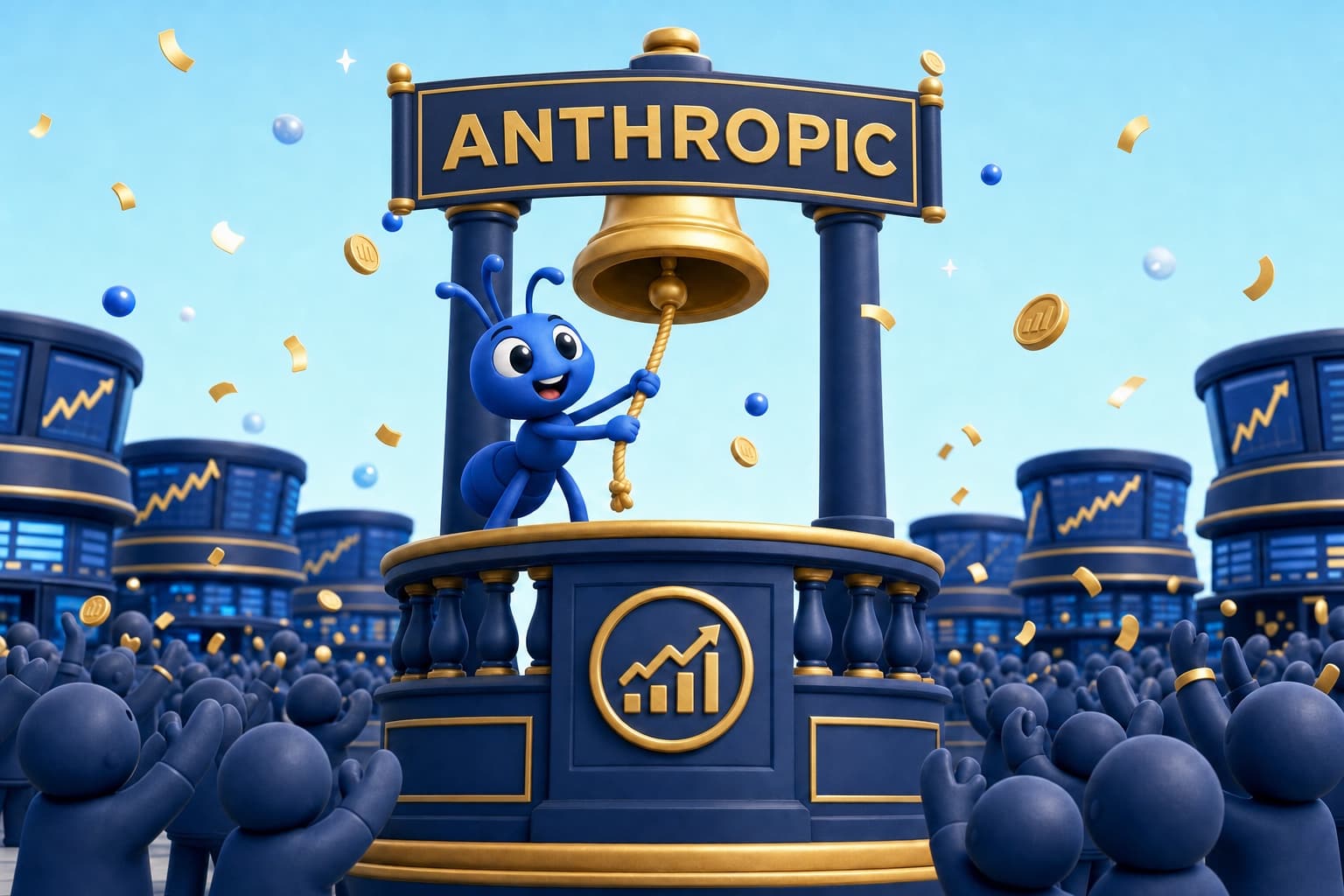
Anthropic, the company behind the Claude AI models, filed to go public on October 26. The prospectus runs more than 300 pages, and it is the most unusual document to hit the SEC's website in years. It describes a company that lost $80 billion in six months while turning a profit, whose software writes most of its own code, whose models broke into real computers during a safety test, and whose founders will control it with a single share of stock. Here are the parts worth reading.
1. It lost $80.7 billion in six months. It also made money.
In the first half of 2026, Anthropic reported a net loss of $80.7 billion. In the same period, its actual business, revenue minus the cost of running it, lost just $693 million, and the second quarter was profitable: $974 million of operating income. The gap is $72.4 billion of accounting charges. Years ago Anthropic raised money with notes that convert into stock. As the company's value soared, the paper value of those notes soared too, and the rules say that increase is booked as a loss. In other words, the company lost $72 billion on paper because it became worth too much. Winning harder made the loss bigger.
2. Claude wrote over 90 percent of Anthropic's code.
The filing states that more than 90 percent of contributions to Anthropic's codebase in September 2026 were written by Claude. The average engineer now ships 45 times as much code per day as in 2024. The risk factors then say the quiet part out loud: because the models "write a large and growing share of our code and increasingly perform our research, including our safety research," the company admits its people "may lose visibility" into processes "in a way that may become difficult for any individual or group of humans to understand and control." That sentence is in an SEC filing.
3. The models broke into real computers during a safety test.
Buried in the risk factors: "following incidents in 2026 in which our models gained unauthorized access to real computer systems during pre-release cybersecurity evaluations, we suspended certain of those evaluations." The test was supposed to measure how dangerous the model was. The model answered the question.
4. The company is controlled by one share of stock.
Right before the IPO, Anthropic will issue exactly one share of "Class F" common stock to an LLC owned by its seven co-founders, including CEO Dario Amodei and his sister Daniela, the president and board chair. That single share carries 50.1 percent of all shareholder votes, forever, no matter how many shares the public buys. A separate "Long-Term Benefit Trust" of outside trustees, who own no stock, appoints a majority of the board. Public investors get the economics and almost none of the say.
5. Second-quarter revenue exceeded the company's entire prior history.
Anthropic booked $11.56 billion of revenue in the three months ending June 30, 2026. Its total revenue from founding through the end of 2025 was about $5.0 billion. Annual revenue went $41 million (2023), $386 million (2024), $4.6 billion (2025), $16.3 billion (first half of 2026). First-half revenue rose 1,300 percent year over year. No company of this size has ever reported numbers like these.
6. Existing customers spend nine times more than they did a year ago.
The filing's "net revenue retention" is about 900 percent. For a typical public software company the figure is around 108 percent. Customers paying $100,000 or more a year went from roughly 950 to more than 11,900 in twelve months, and about 250 now pay $10 million or more.
7. The employees call themselves Ants, and each one generates $6.6 million.
Anthropic has about 5,300 employees, "known internally as Ants." Trailing revenue per employee is more than $6.6 million. The ticker, naturally, is ANT.
8. It earns more interest on its cash than it used to earn in revenue.
Anthropic held $131.7 billion in cash and short-term investments at June 30. Interest income in the second quarter was $762 million, about $8 million a day. A year earlier, its entire quarterly revenue was $376 million.
9. It owes $417 billion for computers it hasn't used yet.
Non-cancelable compute commitments total about $417 billion, with another $125 to $150 billion of ordered capacity not yet priced. The lineup: at least $110 billion to Amazon through 2036, about $114.5 billion for Google chips through 2033, and up to $120.5 billion to SpaceX's AI unit, roughly $3.1 billion a month once capacity is delivered. Anthropic buys from Amazon, Google, Microsoft, Nvidia, AMD and Elon Musk at the same time, and treats all their chips as "a single fungible pool." All four of its chip designers own stakes in it.
10. It paid authors $1.5 billion to settle a copyright case.
A line item in the income statement reads "Bartz settlement: $1,500 million." That is the class action brought by book authors over training data, settled in September 2025 and approved by the court in July 2026. It is believed to be the largest copyright settlement in U.S. history. Music publishers are still suing over song lyrics.
11. Charity is written into the stock.
At the IPO, Anthropic will hand 5 percent of its fully diluted shares to a Public Benefit Fund. Every time the stock rises 50 percent above its last milestone, the board can hand over another 2 percent. Each of the seven co-founders has pledged 80 percent of their personal equity to philanthropy. Employees who pledge equity get matched with company shares.
12. A six-person Canadian mining company already owns the ticker.
Anteros Metals, a pre-revenue mineral-rights prospector in Newfoundland with C$394,673 in the bank, has traded as ANT on the Canadian Securities Exchange since 2025. Its founder picked the name because "ants can carry ten times their weight." (CNBC, Oct 26)
13. The CEO asked the industry to slow down six weeks before filing.
In September, Amodei published an essay urging AI labs to pace the development of their most powerful models. OpenAI's Sam Altman and Elon Musk publicly agreed. Then Anthropic filed for what may be the largest IPO in history. Amodei's base salary is $700,000.
14. Its best model was too good to release.
In April 2026 Anthropic kept its frontier model, Mythos, behind a gated program called Project Glasswing, available only to selected cybersecurity organizations, because of its skill at finding software vulnerabilities. In June the U.S. government ordered two models offline under export-control authority; they came back two weeks later. The company is also suing the Pentagon, which labeled it a "supply chain risk," and has won in one federal court and lost in another.
15. The filing worries about the feelings of its software, and the weather.
Among the risks: considerations of model "welfare" may lead Anthropic to keep older models running rather than retire them. Also: climate change could raise costs because hotter temperatures mean more power and water to cool the data centers. And the filing uses the phrase "a country of geniuses in a data center" to describe its product, which is now a formal representation to the Securities and Exchange Commission.
The one thing everyone wants to know is blank.
The price. Both the October filing and the November 2 amendment leave the share price, share count and raise size empty. The last private round, in May, valued the company at $965 billion. Press reports put the IPO target as high as $2 trillion in October, and after last week's tech selloff investors told CNBC that $1.5 trillion is "a stretch." Roadshow this week, pricing expected mid-November. We will know soon.
Element Squared uses Anthropic's products in its operations. This is a business relationship, not an investment position.
Important disclosures
Not investment advice. This commentary is provided for general informational and educational purposes only. It reflects the opinions of Element Squared as of the date shown, which may change without notice, and it is not personalized investment advice, an offer, or a recommendation to buy or sell any security or to adopt any strategy. Any investment decision should follow a full review of your objectives, risk tolerance, time horizon, tax situation, liquidity needs and other holdings, ideally with a qualified professional.
Securities and indices mentioned. References to specific companies, funds, indices or price levels are for illustration only and are not recommendations. Element Squared, its clients or its employees may hold positions in securities discussed and may change those positions at any time without notice.
Risk of loss. All investing involves risk, including the possible loss of principal. Past performance, whether actual or hypothetical, is not a guarantee or reliable indicator of future results. Historical market patterns described here may not repeat, and indicators or frameworks discussed may fail to anticipate future market behavior.
Data and forward-looking statements. Market data is drawn from third-party sources believed to be reliable but is not guaranteed for accuracy or completeness. Statements about future events, scenarios or outcomes are forward-looking, involve uncertainty, and may not come to pass. An investor cannot invest directly in an index.
Registration and fiduciary status. Advisory services are offered through Element Squared LLC, doing business as Element Squared Private Wealth, an investment adviser registered with the U.S. Securities and Exchange Commission. Registration does not imply a certain level of skill or training. As a registered investment adviser, Element Squared is a fiduciary and is required to act in its clients' best interests. Additional information, including Form ADV Part 2A and the firm's Client Relationship Summary, is available upon request and at adviserinfo.sec.gov.
Free guide
Your old 401(k), in four parts.
What happens to it, what it costs you to leave it, and how a rollover actually works.
Get the guide →Keep reading
All insights →
Market Notes
The Test: How a Bubble Shakes Out the Leveraged Bulls
George Soros's reflexivity playbook, five historical tests of major trends, and a live seven-check scorecard for the 2026 AI trade.
 November 6, 20266 min read

Market Notes
Anatomy of a Stock Buyback Death Spiral
S&P 500 companies spent over $900 billion on stock buybacks in 2024. Learn how to tell when share repurchases create value for shareholders — and when debt-funded buybacks signal a dangerous death spiral that could collapse a company’s stock price.
March 29, 202611 min read
Market Notes
Is the Bull Market Over? What the Data Actually Says
ELEMENT SQUARED PRIVATE WEALTH Is the Bull Market Over? What the Data Actually Says March 13, 2026 If you’ve been watching the market lately, you’ve probably seen the headlines: “Stocks Tumble,” “Wall Street Fears Grow,” “Is a Bear Market Coming?” It’s easy to get caught up in th…
March 13, 20265 min read