
Market Notes
Chase Momentum or Buy What’s Hated? It Depends on Your Calendar
Semiconductors are down 35 percent from June. Health care and staples are at highs. One camp says ride the trend, the other says buy the wreck. Forty years of research says both are right, on different clocks.

Written by Drew Sweetman
Founder, Element Squared Private Wealth

It is the question that has started more arguments than any other in investing, and one we hear from clients every time the market turns: do you chase the sectors that are working, or buy the one everybody hates? The only honest answer is "it depends on your time frame." We think the reason why is worth five minutes of your Thanksgiving week.
The setup
The scoreboard, November 2026
Here is the year so far for the three sectors everyone is arguing about, next to the S&P 500. Everything is indexed to December 31, 2025.
Total return, December 31, 2025 to November 18, 2026
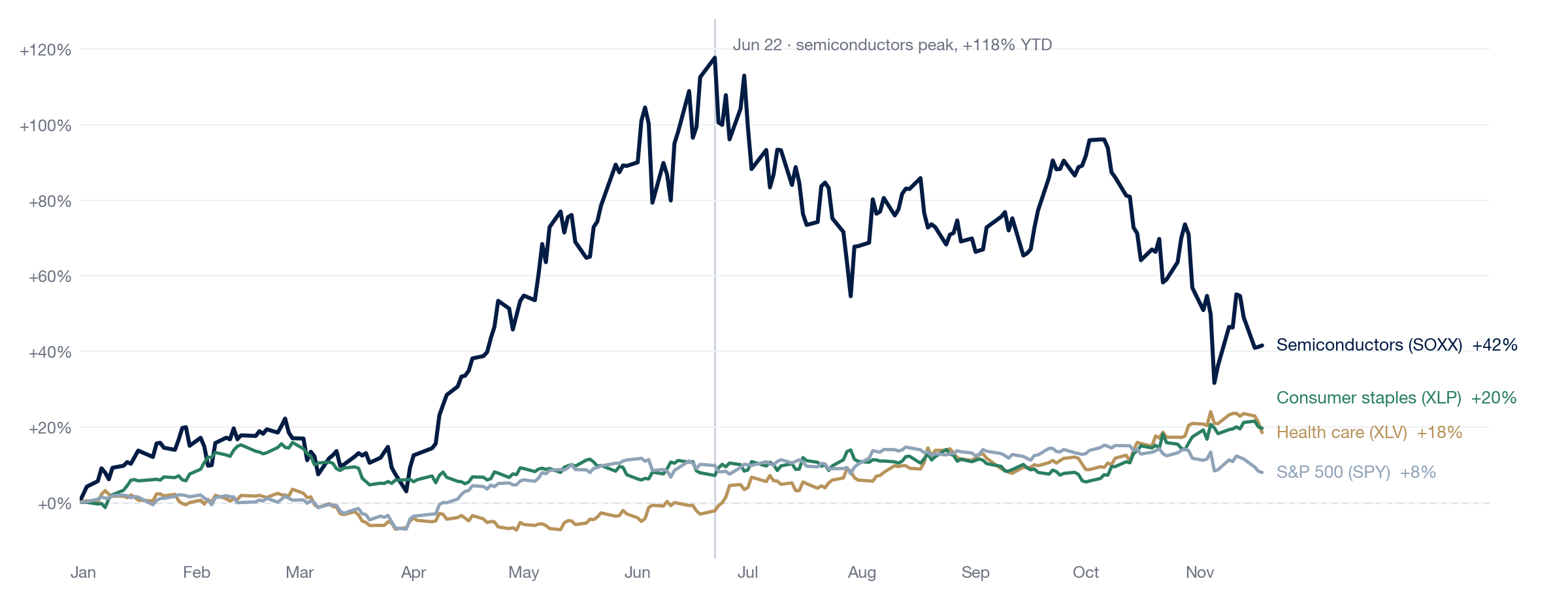
On June 22 the semiconductor fund was up 118 percent for the year and health care was down 2 percent. Since that day semiconductors have fallen 35 percent, health care has gained 21 percent and staples 12 percent. The S&P 500 closed on November 18 at $730.20. Its 200-day moving average is $730.02. You cannot make this up: the index is sitting on the line to the penny.
| Fund | 1 month | 3 months | 2026 to date | vs. 200-day average | From 2026 high |
|---|---|---|---|---|---|
| Semiconductors (SOXX) | −15.2% | −18.1% | +41.6% | −11.7% | −35.0% (Jun 22) |
| Health care (XLV) | +3.1% | +3.5% | +18.5% | +13.4% | −4.5% (Nov 4) |
| Consumer staples (XLP) | +4.6% | +6.1% | +19.6% | +8.3% | −1.5% (Nov 16) |
| S&P 500 (SPY) | −4.7% | −4.8% | +7.9% | 0.0% | −6.3% (Oct 6) |
So the time-frame framing is exactly right. Trend followers own health care and staples today, because that is what trend followers do. Contrarians are eyeing semiconductors, or in the presenter's words, "horror of horrors, semiconductor, because it's been all beaten up and everybody hates it." Both camps are looking at the same chart. Both are certain. Let's see who the evidence favors.
Camp one
1. Ride what is working
The academic case for chasing winners is older than most of the people doing it. In 1993 Narasimhan Jegadeesh and Sheridan Titman published a study in the Journal of Finance showing that stocks that had outperformed over the prior three to twelve months kept outperforming for the next three to twelve months, by roughly one percent a month. Six years later Tobias Moskowitz and Mark Grinblatt showed that a large share of that effect lives at the industry level: whole sectors drift, and the drift lasts for months.
Note the window. Three to twelve months. The momentum crowd is not claiming the trend lasts forever. They are claiming that a sector which has led for the past six months is, on average, more likely than not to lead for the next six. That is a modest claim with a long record behind it, and this year it would have put you in semiconductors for the ride up and started moving you out somewhere in the summer, not at the top, because trend following never sells at the top. It sells late by design and accepts that as the price of never missing a big move.
Camp two
2. Buy what is hated
The academic case for the other side is just as respectable. In 1985 Werner De Bondt and Richard Thaler, who later won a Nobel Prize, published "Does the Stock Market Overreact?" in the same journal. Their finding: portfolios of the worst performers of the prior three to five years went on to beat the prior winners over the following three to five years, by a wide margin. Investors overreact to long runs of bad news, prices overshoot, and patience gets paid.
Note the window again. Three to five years. Semiconductors have been falling for five months and are still up 42 percent on the year. In the De Bondt and Thaler sense, they are not a hated sector. They are a very loved sector having a bad autumn. "Everybody hates it" and "it has been left for dead" are different conditions, and only one of them shows up in the data as a reliable buy.
The resolution
3. Both camps are right, because they are not answering the same question
Put the two findings side by side and the contradiction dissolves. Over the next several months, what has been working tends to keep working. Over the next several years, what has been crushed tends to recover. The trend follower and the contrarian are both reading the same research correctly. They are just standing at different points on the calendar.
The trap is the investor who stands at both. He reads a momentum argument on Monday and buys health care. He reads a contrarian argument on Thursday and buys semiconductors. He has no rule for when either trade is wrong, so he sells whichever one hurts first. He is not practicing sector rotation. He is practicing sector reaction, and the market charges handsomely for that class.
There is a second trap, and it is the one that catches professionals. Trend following works until the trend turns, and the turns are violent. The 35 percent drop in semiconductors since June happened while the sector was still the year's best performer on paper. If your rule says "sell when the trend breaks," you need to have decided what "breaks" means before June, not after.
So what
4. How we help clients sort this out
- We start with the calendar, not the sector. Before anyone talks about semiconductors or health care, we work out with each client how long the money can honestly stay put. Someone who will hold for three to five years can lean into what is out of favor, where the record is good. Someone who checks the account every week is a short-horizon investor whether they admit it or not, and we build around that instead of fighting it.
- We write the exit rule before the entry. Every rotation strategy that has survived has a rule for when it is wrong, set in advance. Our models carry those rules in writing, so when a client asks what would make us sell, the answer already exists. Nobody has to decide in the middle of a 35 percent drop.
- We separate "down" from "cheap." A sector that has doubled and given back a third is in a different place than one that has gone nowhere for five years. The research on buying losers is about the second kind. Part of our job is telling clients which one they are looking at before the headline makes the call for them.
- We use diversification as the time-frame hedge. When a client is not sure which camp they are in, we do not treat that as indecision. Owning both leaders and laggards in sensible proportions is the only approach that works across every window in the research, and that is where most of our client portfolios start.
Our own models each follow written rules and a fixed rebalancing calendar, and those rules were set long before this year's chart existed. That is the entire point. The hard part of sector rotation was never spotting that semiconductors had fallen or health care had risen. Anyone with a chart can see that. The hard part is having decided, in advance, what you were going to do about it, and that is the work we do with clients before the market forces the question.
Months: trends persist
Three to twelve months out, the sectors that have led tend to keep leading. That is the momentum evidence.
Years: losers recover
Three to five years out, the most beaten-down groups tend to beat the former winners. That is the reversal evidence.
Today: know which clock you are on
Decide your horizon and your exit rule first. The trade comes last.
We compare how your current portfolio has behaved against our models over the same periods, and tell you plainly whether a change makes sense.
Sources
Jegadeesh and Titman, "Returns to Buying Winners and Selling Losers: Implications for Stock Market Efficiency," Journal of Finance 48(1), 1993, 65–91 (paper). Moskowitz and Grinblatt, "Do Industries Explain Momentum?", Journal of Finance 54(4), 1999, 1249–1290 (paper). De Bondt and Thaler, "Does the Stock Market Overreact?", Journal of Finance 40(3), 1985, 793–805 (paper). Prices: Yahoo Finance, dividend-adjusted closes through November 18, 2026; all returns are total returns with dividends reinvested. Semiconductors, health care, consumer staples and the S&P 500 are represented by the SOXX, XLV, XLP and SPY exchange-traded funds. The 200-day figure is the simple average of the prior 200 daily closes.
Important disclosures
Not investment advice. This commentary is provided for general informational and educational purposes only. It reflects the opinions of Element Squared as of the date shown, which may change without notice, and it is not personalized investment advice, an offer, or a recommendation to buy or sell any security or to adopt any strategy. Any investment decision should follow a full review of your objectives, risk tolerance, time horizon, tax situation, liquidity needs and other holdings, ideally with a qualified professional.
Securities and indices mentioned. References to specific companies, funds, indices or price levels are for illustration only and are not recommendations. Element Squared, its clients or its employees may hold positions in securities discussed and may change those positions at any time without notice.
Risk of loss. All investing involves risk, including the possible loss of principal. Past performance, whether actual or hypothetical, is not a guarantee or reliable indicator of future results. Historical market patterns described here may not repeat, and indicators or frameworks discussed may fail to anticipate future market behavior.
Data and forward-looking statements. Market data is drawn from third-party sources believed to be reliable but is not guaranteed for accuracy or completeness. Statements about future events, scenarios or outcomes are forward-looking, involve uncertainty, and may not come to pass. An investor cannot invest directly in an index.
Registration and fiduciary status. Advisory services are offered through Element Squared LLC, doing business as Element Squared Private Wealth, an investment adviser registered with the U.S. Securities and Exchange Commission. Registration does not imply a certain level of skill or training. As a registered investment adviser, Element Squared is a fiduciary and is required to act in its clients' best interests. Additional information, including Form ADV Part 2A and the firm's Client Relationship Summary, is available upon request and at adviserinfo.sec.gov.
Free guide
Your old 401(k), in four parts.
What happens to it, what it costs you to leave it, and how a rollover actually works.
Get the guide →Keep reading
All insights →
Market Notes
The Market Just Did Something That Happens Once Every 190 Years. Again.
The S&P 500 closed 4.1 standard deviations below its 50-day average on Friday, a reading the bell curve says comes along twice a millennium. It has now shown up in 1987, 2011, 2015 and this week. The math is wrong, the history is encouraging, and the plan was written in advance.
 November 21, 20264 min read

Market Notes
The “Affair Rally”: We Fact-Checked the Internet’s Worst Trading Strategy
A viral meme says stocks soar after the boss gets caught cheating. We recomputed every number, then read the 325-case study that says the opposite. We do not condone any of it.
November 12, 20269 min read
Market Notes
15 Things in Anthropic’s IPO Filing You Won’t Believe Are Real
It lost $80 billion while turning a profit, its AI writes 90 percent of its code, and one share of stock controls the company. The strangest IPO prospectus ever filed, in 15 facts.
November 8, 20266 min read