
Market Notes
The Test: How a Bubble Shakes Out the Leveraged Bulls
George Soros's reflexivity playbook, five historical tests of major trends, and a live seven-check scorecard for the 2026 AI trade.

Written by Drew Sweetman
Founder, Element Squared Private Wealth

The idea
In a reflexive bubble, rising prices improve the fundamentals. Capital gets cheaper, demand grows, and leverage builds on both. Prices and fundamentals feed each other until the loop is tested. Soros's observation was that every major trend goes through such a test, usually a sharp break, and that what happens next tells you which regime you are in.
The test
Price breaks hard, usually 20 to 35 percent. Margin and momentum holders are forced out, the narrative turns negative, and volatility spikes. This is the uncomfortable part for everyone who owns the asset. It is also where the information is.
The verdict
If the decline fails to clear the bulls, meaning price holds above the prior base, breadth recovers and dip buyers win, the trend has proven itself. If it keeps breaking, the bulls were cleared and the bubble is over.
The acceleration
After a passed test the move extends further and longer than most people expect, because the survivors add size and the doubters capitulate. Investors who held through the test are positioned for it.
We run a direct comparison of how your current portfolio has performed against our models over the same periods, and tell you plainly whether a change makes sense.
Five tests, three outcomes
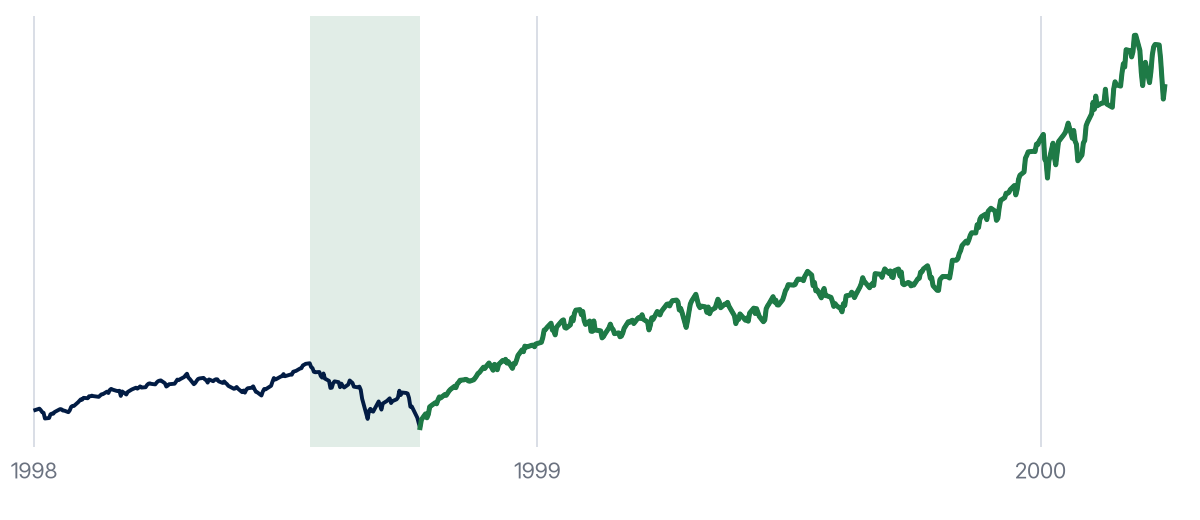
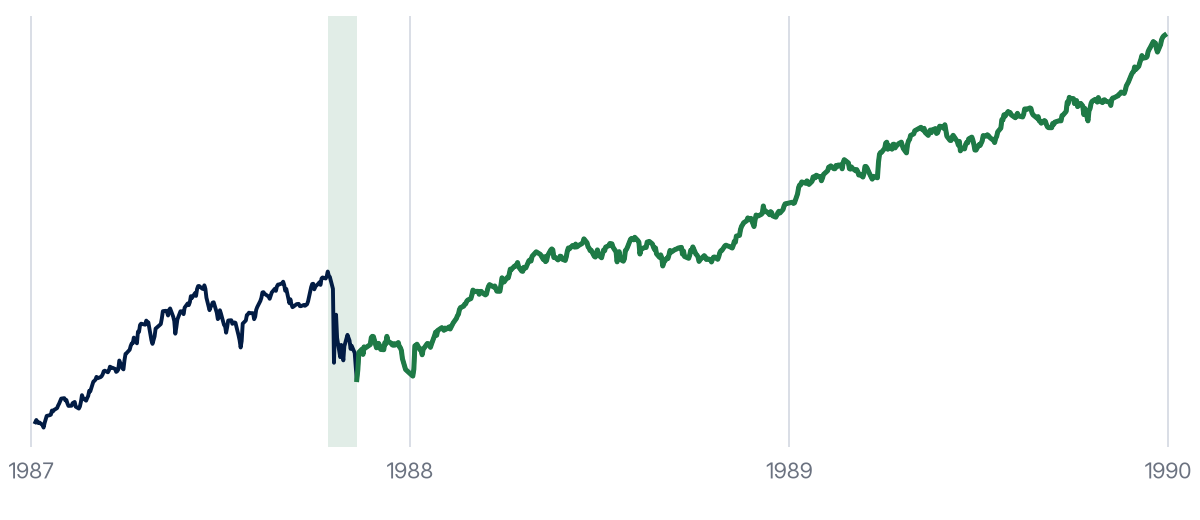
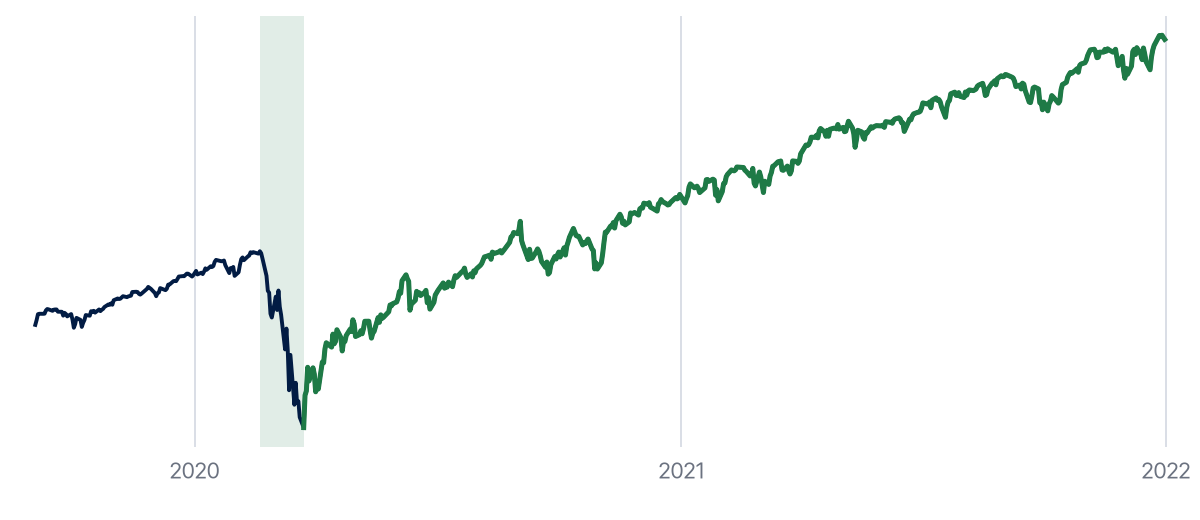
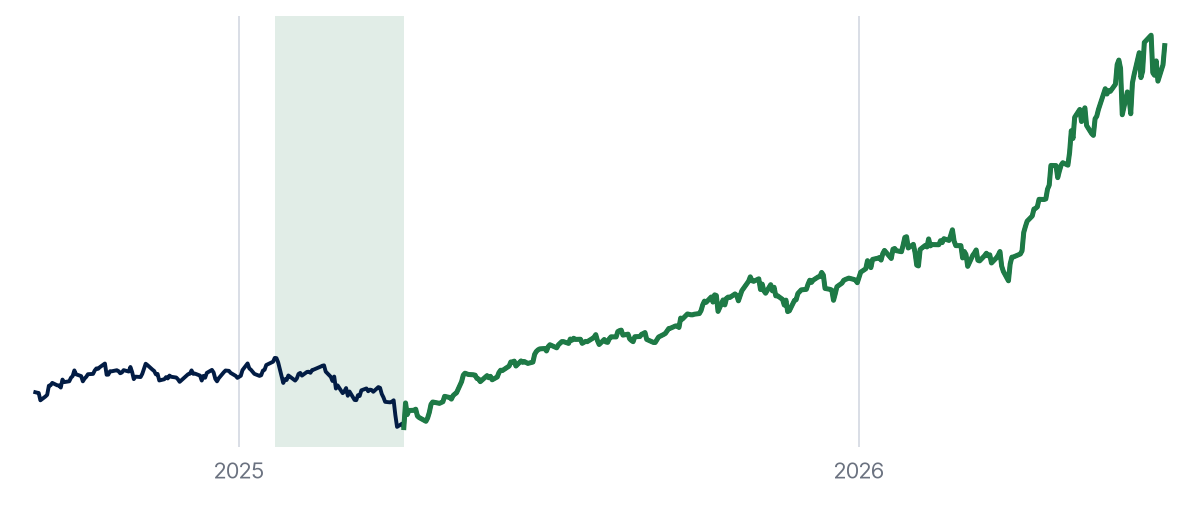
What the test looked like in the past
Test −30% · then +256% in 17 months
Test −21% · then +85% in 2 years
Test −34% · then +114% in 21 months
Test −33% · then +273% in 14 months
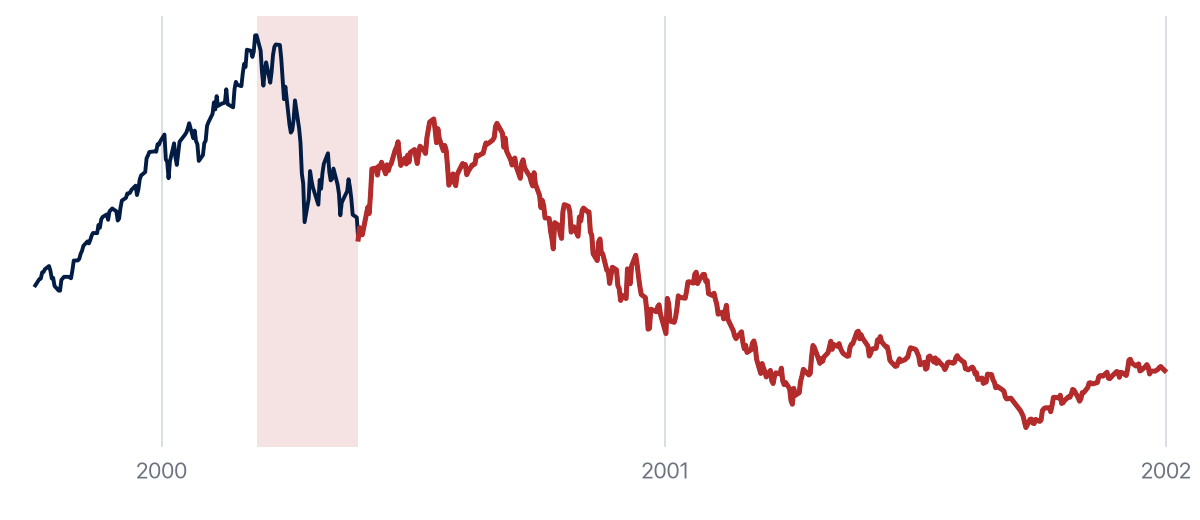
Test −37% · bounce +35% · then −72%
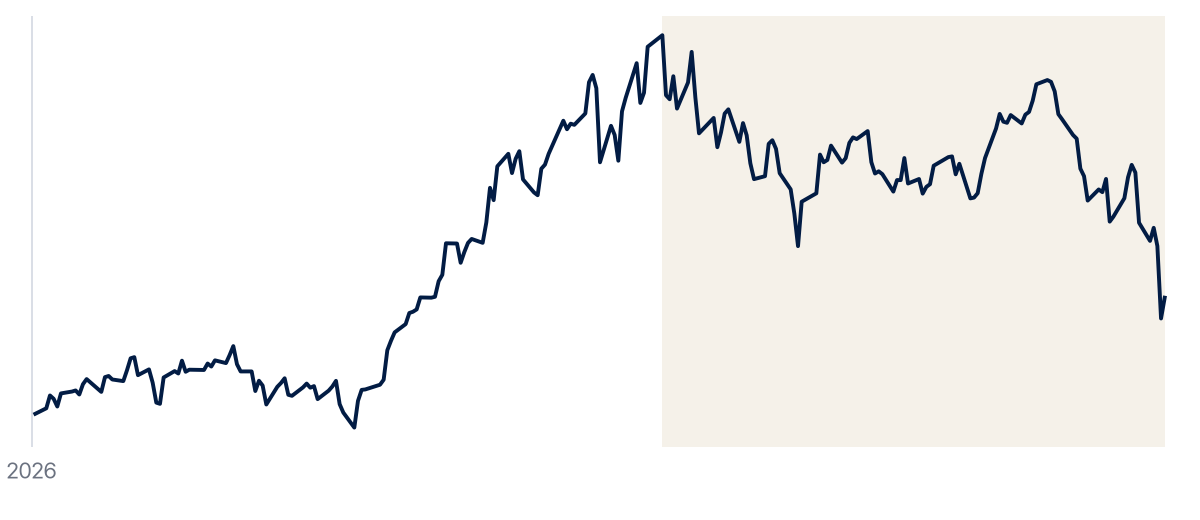
Down 31% from the June high · verdict pending
The passed tests share a pattern: the first break was violent, the low was set within two to three months, breadth recovered quickly and the leaders reclaimed their 200-day moving averages. The one failure looked identical for the first few weeks. The difference showed up afterward, when the bounce faded, the average stock kept breaking and good news stopped lifting prices.
Today: the AI test, scored
Canary indicator 62 / 100 Wobbling as of November 6, 2026
Price is failing the test so far
- Semiconductors (SMH) are down 31% from the June high; the SMH/QQQ ratio sits 12% under its 50-day average.
- The AI core (NVDA, AVGO, ANET, VRT) has lagged the S&P 500 by 23 points over 60 days.
- The neocloud names are 58% to 73% off their highs; high yield has slipped 1.9% against investment grade in 20 days.
- Our Taiwan ODM basket is 7.5% behind the TAIEX; Aspeed, which ships one controller chip per server, is down 31%.
Fundamentals have not confirmed
- Hon Hai's October revenue grew 46% year over year; Wistron is running at roughly twice last year's pace and guided November and December higher.
- Tracked AI data-center power is up 17% in 90 days, with no reported order cuts.
- Inference pricing and GPU rental rates are stable, and the frontier-model release cadence is on schedule.
- DRAM spot prices are flat and the credit markets remain open to the builders.
Our Canary indicator tracks the health of the AI capital-spending chain. A reading in the 60s means the price damage is real, but the supply chain has not yet confirmed it.
The Bull Test
Seven checks, each with a rule set in advance
Verdict: Test running 3 of 7 passed · 0 failed as of November 6, 2026
- The November 5 lows holdSMH, QQQ and NVDA all closed above last Thursday's lows. A close 5% or more below any of them would mean the market is still clearing people.Pass
- The S&P 500 holds its 200-day averageThe index sits about 1% above it. Five straight closes below would mean the test has spread from AI to the whole market.Pass
- The leaders reclaim their 200-dayNeither QQQ nor SMH is back above yet. Every passed test since 1998 did this within about two months; we give it until mid-December.Pending
- Breadth stays intact63% of S&P 500 stocks are above their 50-day average. Below 40% would be the 2000 pattern, where the whole tape broke.Pass
- Fundamentals keep printingQuanta's October revenue, TSMC's October revenue (around November 10) and NVIDIA's November 19 guidance all need to stay on trend. One roll-over fails the check.Pending
- The Canary cools offAmber at 62. Under 40 passes; above 75 means the capex food chain is confirming the price damage.Watch
- The price reaction to NVIDIA on November 19A good guide with the stock down anyway would be the single most damaging tell. Good news that cannot lift price means the bulls have been cleared.Pending
Verdict logic. The bulls are in charge when the four price and breadth checks are green with no fails. The bulls have been cleared on a broken low, a lost 200-day on the S&P 500, a bad reaction to NVIDIA earnings, or any two fails. Otherwise the test is still running.
How it settles
Passed
The AI leaders reclaim the breakdown level on expanding breadth, ODM October and November revenue stays on trend, and the Canary drops back under 40.
Failed
ODM revenue rolls over, hyperscaler 2027 capex guidance is cut, and the Canary rises above 75.
Until one of those prints, the test is still running. We will update this scorecard as the data arrives.
Element Squared research. Indices and funds shown: Nasdaq Composite, Nikkei 225, S&P 500, VanEck Semiconductor ETF (SMH); daily closes from Yahoo Finance. Company revenue figures from monthly filings with the Taiwan Stock Exchange.
Important disclosures
Not investment advice. This commentary is provided for general informational and educational purposes only. It reflects the opinions of Element Squared as of the date shown, which may change without notice, and it is not personalized investment advice, an offer, or a recommendation to buy or sell any security or to adopt any strategy. Any investment decision should follow a full review of your objectives, risk tolerance, time horizon, tax situation, liquidity needs and other holdings, ideally with a qualified professional.
Securities and indices mentioned. References to specific companies, funds, indices or price levels are for illustration only and are not recommendations. Element Squared, its clients or its employees may hold positions in securities discussed and may change those positions at any time without notice.
Risk of loss. All investing involves risk, including the possible loss of principal. Past performance, whether actual or hypothetical, is not a guarantee or reliable indicator of future results. Historical market patterns described here may not repeat, and indicators or frameworks discussed may fail to anticipate future market behavior.
Data and forward-looking statements. Market data is drawn from third-party sources believed to be reliable (including Yahoo Finance and company filings) but is not guaranteed for accuracy or completeness. Statements about future events, scenarios or outcomes are forward-looking, involve uncertainty, and may not come to pass. An investor cannot invest directly in an index.
Registration and fiduciary status. Advisory services are offered through Element Squared LLC, doing business as Element Squared Private Wealth, an investment adviser registered with the U.S. Securities and Exchange Commission. Registration does not imply a certain level of skill or training. As a registered investment adviser, Element Squared is a fiduciary and is required to act in its clients' best interests. Additional information, including Form ADV Part 2A and the firm's Client Relationship Summary, is available upon request and at adviserinfo.sec.gov.
Free guide
Your old 401(k), in four parts.
What happens to it, what it costs you to leave it, and how a rollover actually works.
Get the guide →Keep reading
All insights →
Market Notes
Anatomy of a Stock Buyback Death Spiral
S&P 500 companies spent over $900 billion on stock buybacks in 2024. Learn how to tell when share repurchases create value for shareholders — and when debt-funded buybacks signal a dangerous death spiral that could collapse a company’s stock price.
 March 29, 202611 min read

Market Notes
Is the Bull Market Over? What the Data Actually Says
ELEMENT SQUARED PRIVATE WEALTH Is the Bull Market Over? What the Data Actually Says March 13, 2026 If you’ve been watching the market lately, you’ve probably seen the headlines: “Stocks Tumble,” “Wall Street Fears Grow,” “Is a Bear Market Coming?” It’s easy to get caught up in th…
March 13, 20265 min read
Market Update
November 2026 Market Update
In this video, we’ll talk about recent market activity and how we approach periods of uncertainty. Rather than focusing on short-term market movements, we look at the data and focus on long-term trends. History has shown that staying disciplined and keeping a long-term perspective can…
November 6, 20261 min read